


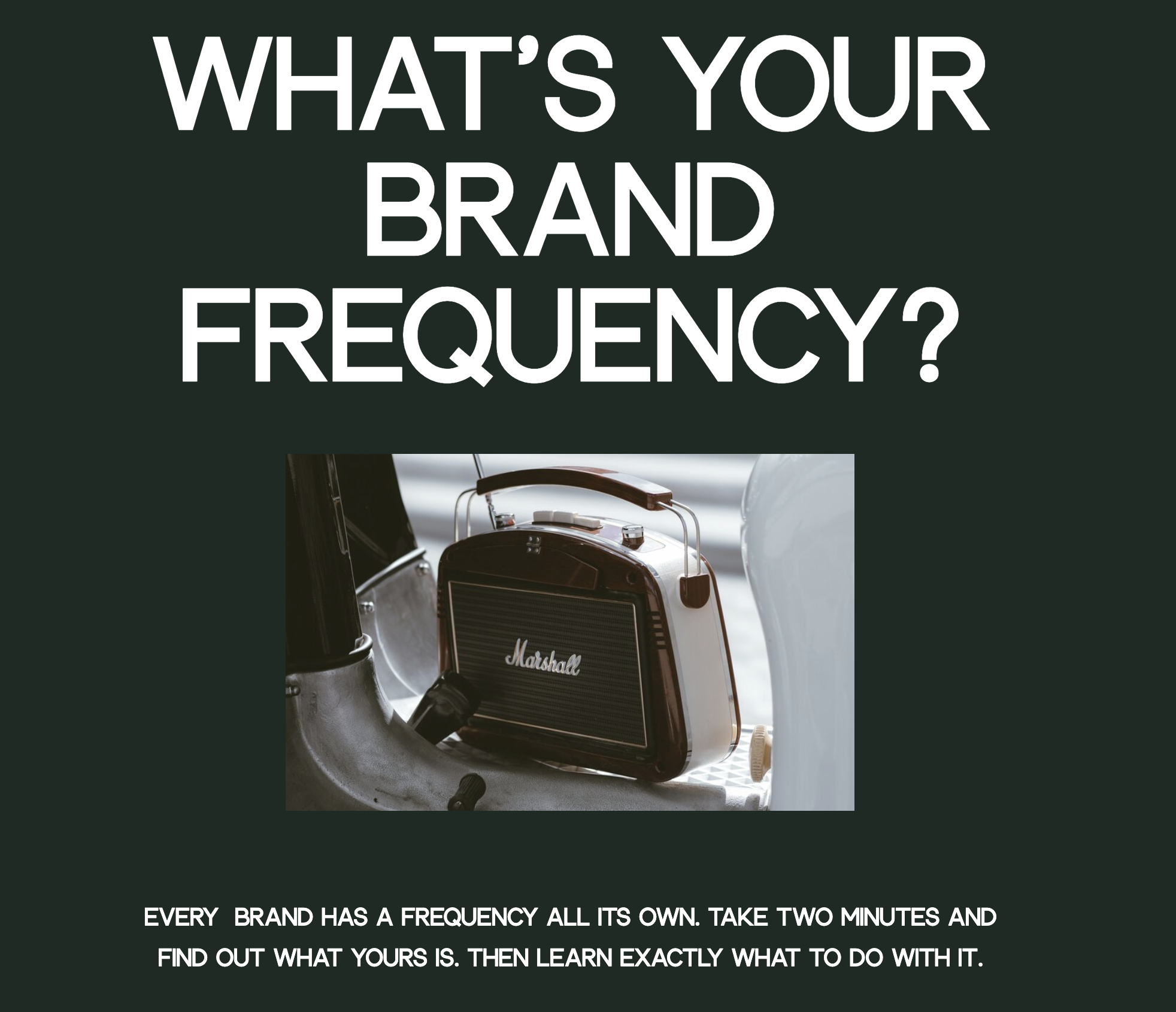
This Interact Quiz Review comes after building my Brand Frequency Quiz on the platform, launching it to my audience, watching people click—and then watching my completion rate tank.
Oddly enough, that last part is one of the reasons I can give you a better review now than I could have on launch day. Building the quiz was easy. Figuring out why people weren’t finishing it gave me a chance to see how useful Interact was once the pretty part was over and I actually needed information.
I used Interact to build a personality-style quiz with five possible Brand Frequency results. The platform handled the logic behind those results, gave me individual results pages, connected the quiz to my email platform so I could segment people by their result, and showed me question-by-question analytics after launch.
Would I use it again? Yep. Even with a completion rate I’m still working on, I’d build this quiz again in a heartbeat.
What surprised me most, though, wasn’t necessarily building the quiz. It was everything I learned once real people started taking it: why a quiz works so differently from a typical PDF lead magnet, how valuable the segmentation can be, and why a quiz that makes someone think too hard is probably going to lose her.
So, if you’re looking at Interact because you’re thinking about building a quiz of your own, here’s what my experience has actually looked like.
Interact Quiz Review: What’s Actually Inside the Platform
Let’s start with Interact itself.
When I decided to build the Brand Frequency Quiz, I needed a personality-style quiz that could sort someone into one of five brand voices. I also needed to be able to connect those results to my email marketing so the quiz wasn’t just something fun people took and forgot about five minutes later.
Interact gave me the pieces to do that without requiring me to code anything.
Personality quizzes vs. scored quizzes
Interact offers a few quiz styles, but the two worth understanding for what we’re talking about here are personality quizzes and scored quizzes.
A personality quiz sorts someone into a type, which is exactly what I needed. Someone answers the Brand Frequency questions and lands in one of five results based on her responses.
Scored quizzes work differently. Those add up points toward an outcome, which makes more sense when you’re trying to diagnose a level or gap instead of identifying a type.
Since I wanted someone to discover something about her brand identity, personality was the obvious choice for me.
The logic builder sounds harder than it is
Any time I hear the word “logic” attached to software, I assume somebody is about to make me do something technical that I don’t want to do.
Thankfully, that’s not what’s happening here.
I’m essentially telling Interact, “If she picks this answer, weight it toward this result.” The platform handles the branching on the back end. It is literally just connecting the dots.
I still have to know what each answer means and which Brand Frequency it should point toward. That’s the strategy behind my quiz. Interact just handles the technical piece that makes those answers eventually lead to the right result.
You can build a separate results experience
The results page may be the most important part of the whole quiz experience because this is what somebody has been waiting for.
She just answered a bunch of questions about herself. Now she wants to know what it means.
For my quiz, that’s the moment she discovers her Brand Frequency.
A good result page has two jobs: give her the payoff she came for and tell her what happens next. You don’t want someone getting all the way through your quiz only to land on a page that basically says, “Congratulations, you’re awesome. Bye.”
You’ve got her attention. Do something with it.
Interact connects the result to email
This was a big reason I wanted a quiz in the first place.
Once someone gets her result, she’s not simply added to my email list with everyone else. Interact connects with my email platform, Flodesk, so she can be tagged according to the Brand Frequency she received.
That gives me information before my first email ever goes out.
I’ll get into what I’m doing with those tags in a minute, because this is where the quiz becomes much more valuable to me than a typical lead magnet.
The analytics ended up being one of my favorite parts
I didn’t build the Brand Frequency Quiz because I was excited about analytics. Well, not totally.
Then my completion rate tanked.
Suddenly, I cared a whole lot about analytics.
Interact shows you what happens question by question, including how many people started and how many made it to the next question. You can download that breakdown and see where people are leaving instead of trying to guess why they didn’t finish.
For me, that became one of the most useful features on the platform.
More on that disaster in a minute.
Interact Quiz Review: Why I’d Use It Again
If you’re waiting for the part where I tell you everything went perfectly, this is not that review.
My first completion rate was ugly.
I still don’t have the after numbers from the changes I’ve made, so I can’t give you a neat little case study that says, “I changed X and my completion rate increased by Y.”
That’s genuinely where I am right now.
Maybe I’ll do an update in a few weeks.
What I can tell you is that building the quiz itself was a good experience from start to finish. More importantly, when something didn’t work the way I wanted, Interact gave me enough information to investigate what was going wrong.
That matters to me.
It’s easy to like a tool when everything works perfectly. I learned more about whether Interact was useful when my numbers weren’t what I wanted and I needed to figure out why.
Instead of one overall number telling me people weren’t finishing, I could dig into where they were leaving. Once I knew that, I had something specific to work on.
So yes, even while I’m still testing the revised version, I’d build the quiz again.
Why Quizzes Work Differently From a PDF Lead Magnet
Now let’s talk about why I wanted a quiz in the first place, because I think this is where things get really interesting.
Most lead magnets sell information.
A quiz sells self-discovery.
That’s a completely different reason to opt in.
Nobody wakes up excited because there’s another “10 Tips for Branding” PDF available to download. Almost everybody, however, wants to know what her result says about her.
“What’s my Brand Frequency?” creates curiosity.
You have to take the quiz to get the answer.
That curiosity pulls someone through the questions in a way that “here’s a free guide” doesn’t. A PDF can sit in your downloads folder forever—and let’s be honest, plenty of them do.
With a quiz, someone either reaches the result or she doesn’t. That gives you a number you can actually watch and improve.
I learned the importance of that number almost immediately.
Clicks and completions tell you different things
When I launched the Brand Frequency Quiz, the view rate was exactly what I wanted.
People were clicking.
They were showing up.
If I’d stopped there, I would have been feeling pretty good about myself.
Then I looked at completions.
Tanked.
Not a little off. Tanked.
That told me something important. Getting people interested enough to click wasn’t my problem. Something was happening after they entered the quiz.
Those are two completely different problems.
Instead of wondering how to get more traffic, I needed to figure out where I was losing the people who were already interested.
That’s a much more useful question.
Interact Quiz Review: The Segmentation Is a Big Deal
There’s another reason a quiz works differently from a standard PDF or checklist: you learn something about the person who just joined your list.
Someone who lands in The Cover Band is different from someone who lands in The Feedback Loop. She may have different fears, respond to different language, or be holding herself back for a completely different reason.
By the time she finishes the quiz, I already know something true about her.
A checklist can’t do that for me.
And I didn’t want to waste that information.
I built separate email sequences for every result
Instead of creating one generic welcome email for everyone who takes the quiz, I built four to five emails for each of the four Brand Frequency outcomes.
Yes, that is a lot of emails.
But if I’m going to go through all the work of learning which result someone gets, why would I turn around and talk to everyone exactly the same way?
Someone who gets The Unplugged Artist is getting a sequence written for someone who’s probably holding back and needs permission to take up more space. The Broken Amplifier gets something completely different because her hesitation isn’t the same.
The goal isn’t to write one sequence that sort of speaks to everybody.
Each person gets follow-up that sounds like it was written for her.
Because it was.
That’s the promise of the quiz as a lead magnet. The quiz gets someone in the door and tells you who she is. Your emails are where you prove you were listening.
Interact Quiz Review: What the Analytics Taught Me
Okay, back to my tanked completion rate.
Once I saw the number, I could have come up with all kinds of explanations.
Maybe the quiz was too long. Maybe people didn’t care enough about finding out their Brand Frequency. Maybe the whole idea wasn’t as interesting as I thought it was.
Guessing wouldn’t have helped me fix anything.
Instead, I pulled the question-by-question numbers straight out of Interact and ran them through AI to help me spot the pattern faster than I could staring at a spreadsheet.
The drop-off wasn’t random.
People were leaving at specific questions.
When I looked at what those questions had in common, one thing stood out: my answer options were too complex.
And honestly, once I saw it, it made complete sense.
I was asking people to think too hard. Who wants to do that in a quiz?!
When you’re the person creating the quiz, you’re thinking about all the strategy underneath it.
I know what separates one Brand Frequency from another. I know why certain answers point toward one thing while others point toward another. Naturally, I wanted the answer options to capture all those nuances.
The person taking my two-minute personality quiz did not sign up for any of that.
She wants to read a question, look at the options, recognize herself, and click.
Mine were asking for more mental effort than people were willing to give.
A quiz has to feel light.
That’s probably one of the biggest things building my own taught me. You can put plenty of strategy behind the quiz, but the person taking it shouldn’t have to feel all of that strategy.
If she has to stop and analyze every answer, you’ve made her work too hard.
Apparently, I had.
What I Changed After My Completion Rate Tanked
Once the analytics showed me where people were leaving, I didn’t rebuild the entire quiz.
There was no reason to.
The answer options were the problem, so that’s what I changed.
I sat down with my AI assistant and reworked them to be simpler and faster to read. The goal was to let someone recognize herself in an answer without having to stop and process a full explanation.
Along with simplifying the language, I added emojis to each option. And I added one more category where we saw a gap.
Now, I want to be really clear about this part because I’m not interested in turning something I’m testing into a fact.
There’s research floating around suggesting emojis in quiz answers can help completion because someone can recognize an option at a glance instead of reading and processing a whole sentence.
I haven’t verified that stat myself.
So take it as a direction worth testing, not a guarantee.
The simpler answer options are a direct response to what I saw in my analytics. Emojis are another thing I’m testing alongside that change.
I’ve now redeployed the revised quiz to my email list, and I’m watching to see what happens.
I don’t have the after numbers yet.
I’ll tell you when I do.
Interact Quiz Review: What Building My Own Quiz Taught Me
Building the Brand Frequency Quiz taught me more than how to use Interact.
For one thing, a good click rate can make you feel like everything is working when it isn’t. If I hadn’t looked at completions, I wouldn’t have seen the problem.
Once I knew there was a problem, the next lesson was not to guess. Question-level analytics gave me a much better place to start than changing random things and hoping something improved.
The experience also changed the way I think about how much work a quiz should require from the person taking it. I can make the strategy behind the scenes as detailed as I want. Her side needs to feel simple.
Then there’s the segmentation.
This may end up being one of the most valuable parts of the whole thing for me. Instead of collecting an email address and knowing almost nothing else, I’m starting the relationship with information I can actually use to make the follow-up more relevant.
But there’s a catch.
You have to follow through.
The quiz is only the beginning
A lead magnet like this only works if what it feeds into is ready to catch someone.
You can build a beautiful quiz, but if the website behind it doesn’t hold up, you’ve got a problem. The same goes for email. A personalized result followed by generic messaging doesn’t make much sense.
The quiz gets someone curious.
Your brand, your website and your communication are what make her stay.
For me, that means the result page, email sequence, website, and whatever happens next all need to feel like pieces of the same experience.
Interact can help me build and deliver the quiz.
What happens after that is still my job.
Interact Quiz Review: Would I Recommend Building a Quiz?
Here’s where I land after actually building one.
Even with a completion rate I’m still working on, I’d do it again in a heartbeat.
A quiz gives me something I don’t get from a typical PDF lead magnet. The person taking it gets a result she’s genuinely curious about, while I get information that can help me understand who just joined my list.
Interact made building that experience straightforward for me. When the first numbers came in ugly, the analytics also gave me somewhere to look instead of leaving me guessing.
Do I have everything figured out?
Absolutely not.
The revised quiz is out there now, and I’m still waiting to see whether simplifying the answers and adding emojis changes the completion rate.
Maybe it makes a big difference.
Maybe it doesn’t.
I don’t know yet, and that’s the point of testing it.
What I do know is that the first version taught me exactly what I needed it to teach me: people were interested enough to start, I was making it too hard for some of them to finish, and the data gave me a way to see the difference.
That’s useful.
Interact Quiz Review FAQ
What is Interact?
Interact is the platform I used to build my Brand FrequencyQuiz. I used it to create a personality-style quiz, set up the logic connecting answers to results, build results pages, connect those results to my email platform, and review question-by-question analytics after launch.
What types of quizzes can you build in Interact?
The two types I focused on were personality quizzes and scored quizzes. Personality quizzes sort someone into a type, while scored quizzes add up points toward an outcome.
I chose a personality quiz because Brand Frequency is about identifying which of four brand voices someone naturally leads with.
Does Interact connect quiz results to email?
That’s how I’m using it. Once someone gets her Brand Frequency result, she’s tagged according to that outcome rather than simply being added to one generic list.
I’ve built four to five follow-up emails for each of my four Brand Frequency results.
What did I like most about Interact?
The analytics ended up being especially valuable for me. Once my completion rate came in lower than I wanted, I could see where people were dropping off question by question instead of guessing about what had gone wrong.
That led me directly to the complexity of my answer options.
Why weren’t people finishing my quiz?
Based on the question-level analytics, the drop-off was concentrated around specific questions. Those questions had answer choices that required too much thought for what was supposed to feel like a quick personality quiz.
I’ve since simplified the answer options and redeployed the quiz.
Did the changes improve my quiz completion rate?
I don’t know yet.
The revised quiz is currently being tested, and I don’t have the after numbers. I simplified the answer choices and added emojis, but I’m waiting for the data before making any claims about whether those changes worked.
My Final Interact Quiz Review
Would I build another quiz inside Interact?
Yep.
Building mine was genuinely a good experience from start to finish, and the platform became even more useful when my first numbers weren’t what I wanted. Instead of shrugging and assuming the quiz didn’t work, I had enough information to figure out where people were leaving and make a specific change.
That’s where I am right now.
No magical after number. No perfect little case study tied up in a bow.
I built it. I launched it. The completion rate tanked. I figured out what looked like the problem, changed it, and sent it back out.
Now I’m watching.
If you want to see exactly what I’ve been talking about, go take the Brand Frequency Quiz. You’ll get one of the four Brand Frequency results and land in one of those email sequences I built around the outcomes.
And if taking mine gets you thinking about what kind of quiz you could build for your own business, use my Interact discount link to try building your own.



Comments +